The flavors and texture of a classic German Pretzel, turned into a braided loaf, this Pretzel bread is perfect for toasts, sandwiches or just eating with butter.

What makes German Pretzels different?
German Pretzels are different than any other kind of pretzel for many reasons. First is their texture, they aren’t hard and crunchy like the tiny ones you snack on as a kid. And while soft they aren’t overly gummy and squishy like the ones you get in nyc from a street cart. Second is that they are traditionally dipped in food grade lye which not only gives them the classic dark brown color but also gives them that distinctive pretzel flavor!
What gives pretzels their color and flavor?
Lye is what gives pretzels their distinctive color and flavor. It can seem scary to use lye because it is toxic until baked BUT with just a few safety precautions you’ll be just fine! It’s important to use food grade lye when working with food. Here are some more tips to keep in mind:
- Work in a well ventilated area, such as by a window. After the lye has dissolved most of the fumes will have evaporated, so just put the bowl by the window while stirring to combine.
- Always sprinkle the lye into the water, do not pour the water into a bowl with the lye beads already in it.
- Wear long sleeves, long pants, gloves, and eye protection.
- Remember to only use stainless steel or glass when working with lye as it will react with other materials.
- Cover your work surface with parchment paper if you’re worried about spilling/ damaging the surface.
- Once finished, the mixture can be neutralized by pouring in white vinegar. It can be poured down the drain as is because (don’t freak out) it is the base for drain cleaners. If you are concerned, simply add the white vinegar and then pour it down the drain.
What can I use instead of Lye?
Many people use baking soda boiled in water as an alternative because it isn’t toxic and will give a “similar” taste. I have tried this method as well but I don’t think it really does the trick. If you make these, I highly recommend using lye for the full effect. If you do decide to go with the baking soda bath, here is an article from King Arthur Baking about using a baking soda bath for pretzels.
How to get a good crust on homemade bread?
The key to a good thick crust on bread is steam which can be really hard to recreate in a classic home oven. The best way to get a thick crust is to bake the bread in a cast iron dutch oven with the lid on for the first half and then remove the lid in the second half. If you don’t have a dutch oven the bread will still be delicious, the crust just won’t be as thick.
Additional Recipes to try:
Tips for making Pretzel Bread
- This dough is stiff so make sure your mixer is set on low speed. You don’t have to use a mixer for this dough as it comes together pretty quickly but if you are kneading it by hand, start in a bowl until it all sticks together and then dump it out and knead until smooth. It’s important the dough is smooth though it doesn’t have to pass the window pane test.
- Rising/proofing time will vary depending on the temperature of your water, butter, and room. The key with this bread is to not let it overproof. The main goal with the first proof is to let the dough relax. I usually let it sit for about 30-45 minutes until puffy and soft. It doesn’t need to be huge.
- This recipe uses instant yeast because it’s easier and usually what I have on hand. If you use active dry, I recommend stirring it in with the water and leaving it to sit for 5-10 minutes, until bubbly, before adding it to the flour.
- Don’t use extra flour when shaping the logs for the braid because the dough is already quite dry.
- Make sure to roll the logs up tightly so there aren’t any air bubbles inside.
- Immediately after shaping the bread, place it in the fridge so it can firm up without over proofing.
- Don’t start the lye (or baking soda bath) process until your oven has heated. The pretzels become quite sticky once they have been dipped and you don’t want all the extra moisture soaking in to them.
- Be sure to bake until it becomes dark brown. The lye will cause it to darken so allow it to do it’s work and bake it for the full amount of time.
- Slice leftovers and freeze in a freezer safe bag. Toast leftovers in the oven for a delicious sandwich.
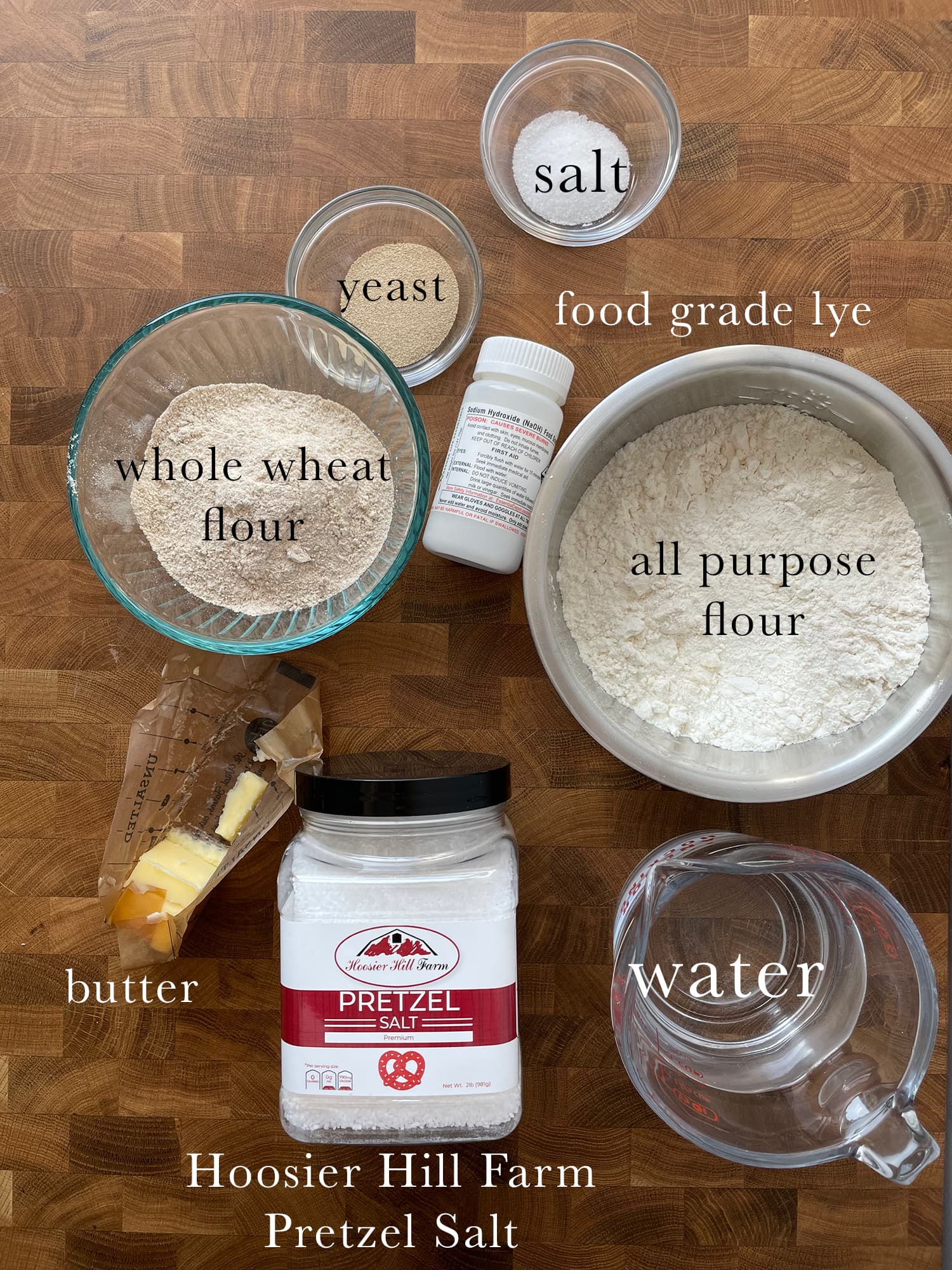
Ingredients
- All Purpose Flour: I love this recipe because it uses all purpose flour and whole wheat flour, both of which are easy to find. I recommend King Arthur Baking All Purpose flour!
- Whole Wheat Flour: While rye flour is very common in most German Pretzels to give them more depth of flavor, I have chosen to use whole wheat flour because it is easier to find but still gives a delicious flavor to the pretzels.
- Water: I have always used tap water where I have lived and never had issues but many people like to use filtered water or bottled water.
- Instant yeast: I like to use instant yeast because it can be whisked in with the flour and doesn’t need to be bloomed first. That being said, active dry yeast can be used as well!
- Fine Sea Salt: This recipe uses two types of salt, fine sea salt should be used in the dough itself, just be sure to add it after the yeast has been whisked in to keep it from killing the yeast.
- Butter: Traditionally, a small amount of butter is added to the dough for richness and flavor.
- Pretzel Salt: Basically the key to making these yummy pretzels is Hoosier Hill Farms Pretzel Salt, it is larger than regular salt and won’t dissolve into the pretzels.
- Lye: Lye is what gives pretzels their distinctive color and flavor. It can be intimidating to use at first but the results are so worth it and once you’ve done it a couple of times, it becomes much easier and less daunting. This is the lye that I used.

How to make Homemade Pretzel bread
Dough
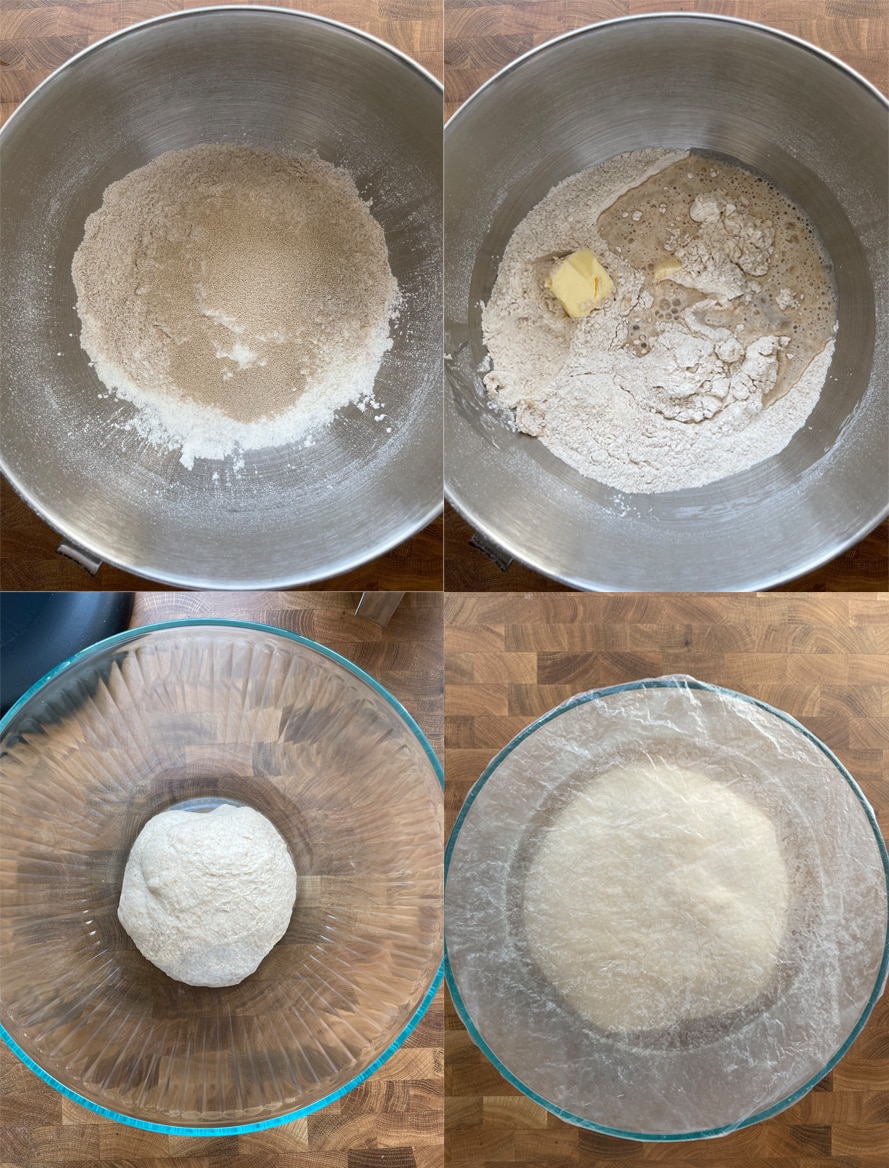
- In the bowl of a stand mixer, whisk together the all purpose flour (350 grams), the whole wheat flour (150 grams) and the instant yeast (8 grams).
- Pour in the lukewarm water (300 grams), softened butter (15 grams), and fine sea salt (10 grams).
- Use the dough hook attachment to knead the dough on low speed until smooth, about 10-15 minutes.
- Shape the dough into a ball and place back in the mixing bowl. Cover the bowl with a lid or some sort of cover. Set aside to rise and until doubled in size, about 30-45 minutes.
Shape
Part 1: The log
- Once puffy and relaxed, knock the air out of the dough by punching it down.
- Pat the dough into a fat square. Use a bench scraper, knife, or your hands to divide the dough into 3 equal logs.
- Working with one log at a time, pat the dough into a flat(ish) log. Then use a rolling pin to roll it out to about 18-20 inches long and 4-5 inches wide.
- With the log laid out in front of you horizontally, start with the long side closest to you and start to roll it up but after each fold/roll, smush the edge into the rest of the log to press out any extra air.
- Continue this folding and sealing until the flattened log is rolled up into a tight log. When you get to the opposite long side, seal the edge to the rest of the rolled log by pinching the edge into the log.
- Place the log seam side down and use the heals of your hands to roll the log to about 24″-26″ long. For a traditional shape, keep the center thicker with the ends a bit thinner.
- If needed, rub a little olive oil on your hands and work surface to create a bit of tension.
Part 2: The Braid
- Once all three logs have been rolled, lay them out vertically in front of you. Stack the ends furthest away from you on top of each other with the log on the right under the center one and the log on the left on top.
- Then, cross the right strand over the center. Followed by the left strand over the center. Continue braiding in this pattern, keeping the strands tight together but not stretched.
- Once you reach the end, press the ends together by stacking them again. If the braid isn’t tight where you started, peel the strands apart and add a couple extra crosses of the strands and press them back together.
- You should now have a braid with both sets of ends stacked to keep them from coming undone.
- Starting with one end of the braid, roll it into a snail shape, tucking the starting end under the bread and ending by tucking the ending tail under the bread as well.
- Transfer the shaped pretzel onto a parchment lined baking sheet or plate and place it in the fridge, uncovered.
- Place an oven rack just below the center and place the dutch oven on it. Heat the oven to 450 F.

Lye Bath
- Line two half sized baking sheets with parchment paper big enough to cover the pan. On one of the baking sheets, stack two sheets of parchment in opposite directions.
- Once the oven is hot and the bread has been in the fridge for an 45 minutes, it’s time for the lye bath. Refer to the tips section earlier in the blog post for all the information and precautions when working with lye! Most importantly, wear gloves, eye protection, work in a well ventilated space, use a glass or stainless steel bowl, and add the lye into the water, not the other way around.
- In a large glass bowl, add in 1 liter of water. Sprinkle with 37 grams of food grade lye. Use a stainless steel slotted spoon to stir it until the water becomes clear again. This is when the majority of the fumes will be released so I recommend being close to the window or even outside for this part.
- Place the bowl with the lye bath on the baking sheet with one sheet of parchment paper.
- Take the bread out of the fridge. With gloves on carefully flip the bread over into the lye bath and let it float for 15 seconds.
- Carefully lift the bread out of the lye bath with one or two slotted stainless steel tools. Allow the excess lye bath to drip off.
- Flip the pretzel bread back over onto the second parchment lined baking sheet.

Salt & Bake
- Sprinkle the top of the bread with your desired amount of pretzel salt. I like a lot but you can always do less if you prefer.
- Take the dutch oven out of the oven and place on a wire rack close to the bread. Take the lid off, careful it will be VERY hot so make sure to use pot holders or an oven mitt.
- Lift the bread by holding both sheets of parchment and carefully lower them into the hot dutch oven.
- Place the lid back on the dutch oven and put it back in the oven.
- Set the timer for 20 minutes.
- After 20 minutes, take the lid off of the dutch oven. Bake for another 20 minutes until it becomes a dark golden brown.
- Remove the dutch oven and bread from the oven. Use the parchment to carefully lift the baked bread out of the dutch oven and place it on a wire cooling rack to cool.
- Allow the bread to cool completely before slicing (if you can).



Pretzel Bread
Equipment
- Cast Iron Dutch Oven
- Large Glass Bowl
- Stainless Steel Slotted Spoon
- Stand Mixer semi optional
Ingredients
Dough
- 350 grams all purpose flour
- 150 grams whole wheat flour
- 8 grams instant yeast
- 10 grams fine sea salt
- 15 grams butter soft
- 300 grams water lukewarm
Lye Bath
- 1 liter cold water
- 37 grams food grade lye
Salt
- 20 grams pretzel salt
Instructions
Dough
- In the bowl of a stand mixer, whisk together the all purpose flour (350 grams), the whole wheat flour (150 grams) and the instant yeast (8 grams).
- Pour in the lukewarm water (300 grams), softened butter (15 grams), and fine sea salt (10 grams).
- Use the dough hook attachment to knead the dough on low speed until smooth, about 10-15 minutes.
- Shape the dough into a ball and place back in the mixing bowl. Cover the bowl with a lid or some sort of cover. Set aside to rise and until doubled in size, about 30-45 minutes.
Shaping
- Once puffy and relaxed, knock the air out of the dough by punching it down.
- Pat the dough into a fat square. Use a bench scraper, knife, or your hands to divide the dough into 3 equal logs.
- Working with one log at a time, pat the dough into a flat(ish) log. Then use a rolling pin to roll it out to about 18-20 inches long and 4-5 inches wide.
- With the log laid out in front of you horizontally, start with the long side closest to you and start to roll it up but after each fold/roll, smush the edge into the rest of the log to press out any extra air.
- Continue this folding and sealing until the flattened log is rolled up into a tight log. When you get to the opposite long side, seal the edge to the rest of the rolled log by pinching the edge into the log.
- Place the log seam side down and use the heals of your hands to roll the log to about 24"-26" long. For a traditional shape, keep the center thicker with the ends a bit thinner.
- If needed, rub a little olive oil on your hands and work surface to create a bit of tension.
- Once all three logs have been rolled, lay them out vertically in front of you. Stack the ends furthest away from you on top of each other with the log on the right under the center one and the log on the left on top.
- Then, cross the right strand over the center. Followed by the left strand over the center. Continue braiding in this pattern, keeping the strands tight together but not stretched.
- Once you reach the end, press the ends together by stacking them again. If the braid isn't tight where you started, peel the strands apart and add a couple extra crosses of the strands and press them back together.
- You should now have a braid with both sets of ends stacked to keep them from coming undone.
- Starting with one end of the braid, roll it into a snail shape, tucking the starting end under the bread and ending by tucking the ending tail under the bread as well.
- Transfer the shaped pretzel onto a parchment lined baking sheet or plate and place it in the fridge, uncovered.
- Place an oven rack just below the center and place the dutch oven on it. Heat the oven to 450 F.
Lye Bath
- Line two half sized baking sheets with parchment paper big enough to cover the pan. On one of the baking sheets, stack two sheets of parchment in opposite directions.
- Once the oven is hot and the bread has been in the fridge for an 45 minutes, it's time for the lye bath. Refer to the tips section earlier in the blog post for all the information and precautions when working with lye! Most importantly, wear gloves, eye protection, work in a well ventilated space, use a glass or stainless steel bowl, and add the lye into the water, not the other way around.
- In a large glass bowl, add in 1 liter of water. Sprinkle with 37 grams of food grade lye. Use a stainless steel slotted spoon to stir it until the water becomes clear again. This is when the majority of the fumes will be released so I recommend being close to the window or even outside for this part.
- Place the bowl with the lye bath on the baking sheet with one sheet of parchment paper.
- Take the bread out of the fridge. With gloves on carefully flip the bread over into the lye bath and let it float for 15 seconds.
- Carefully lift the bread out of the lye bath with one or two slotted stainless steel tools. Allow the excess lye bath to drip off.
- Flip the pretzel bread back over onto the second parchment lined baking sheet.
Salt & Bake
- Sprinkle the top of the bread with your desired amount of pretzel salt. I like a lot but you can always do less if you prefer.
- Take the dutch oven out of the oven and place on a wire rack close to the bread. Take the lid off, careful it will be VERY hot so make sure to use pot holders or an oven mitt.
- Lift the bread by holding both sheets of parchment and carefully lower them into the hot dutch oven.
- Place the lid back on the dutch oven and put it back in the oven.
- Set the timer for 20 minutes.
- After 20 minutes, take the lid off of the dutch oven. Bake for another 20 minutes until it becomes a dark golden brown.
- Remove the dutch oven and bread from the oven. Use the parchment to carefully lift the baked bread out of the dutch oven and place it on a wire cooling rack to cool.
- Allow the bread to cool completely before slicing (if you can).
Notes
- This dough is stiff so make sure your mixer is set on low speed. You don’t have to use a mixer for this dough as it comes together pretty quickly but if you are kneading it by hand, start in a bowl until it all sticks together and then dump it out and knead until smooth. It’s important the dough is smooth though it doesn’t have to pass the window pane test.
- Rising/proofing time will vary depending on the temperature of your water, butter, and room. The key with this bread is to not let it overproof. The main goal with the first proof is to let the dough relax. I usually let it sit for about 30-45 minutes until puffy and soft. It doesn’t need to be huge.
- This recipe uses instant yeast because it’s easier and usually what I have on hand. If you use active dry, I recommend stirring it in with the water and leaving it to sit for 5-10 minutes, until bubbly, before adding it to the flour.
- Don’t use extra flour when shaping the logs for the braid because the dough is already quite dry.
- Make sure to roll the logs up tightly so there aren’t any air bubbles inside.
- Immediately after shaping the bread, place it in the fridge so it can firm up without over proofing.
- If you can’t get lye, many people use baking soda boiled in water as an alternative because it isn’t toxic and will give a “similar” taste. I have tried this method as well but I don’t think it really does the trick. If you make these, I highly recommend using lye for the full effect. If you do decide to go with the baking soda bath, here is an article from King Arthur Baking about using a baking soda bath for pretzels.
- Don’t start the lye (or baking soda bath) process until your oven has heated. The pretzels become quite sticky once they have been dipped and you don’t want all the extra moisture soaking in to them.
- Be sure to bake until it becomes dark brown. The lye will cause it to darken so allow it to do it’s work and bake it for the full amount of time.
- Slice leftovers and freeze in a freezer safe bag. Toast leftovers in the oven for a delicious sandwich.
Nutrition
This page may contain affiliate links. This means that if you click on one of the product links above and complete a purchase, I’ll receive a small commission at no extra cost to you. I will never place a link nor make a recommendation on a product or service that I don’t love or use personally. Read our privacy policy here. Thank you for supporting Red Currant Bakery.



Made this bread. only issue could not find Lye in the neighborhood grocery stores. Had to make do with baking soda. so did not get the dark color.